Friday, July 31, 2015

The John V. Moran discovered by divers

“DIVERS FIND PRISTINE 116-YEAR-OLD SHIPWRECK IN LAKE MICHIGAN
Divers discovered a 116-year-old shipwreck at the bottom of Lake Michigan that is being called one of the best-preserved wrecks in the Great Lakes. The John V. Moran is also one of the deepest wrecks dived in the expansive lake that is home to some 2,000 sunken vessels dating back to the 1800s. Only 360 have been found thus far. "The John V. Moran has been on our hit list for quite a while," said Craig Rich, co-director of the Michigan Shipwreck Research Association. "We've quietly been researching it, and decided this year we'd go out after it." The story of the John V. Moran began unfolding in February 1899. The 214-foot ship was traveling Lake Michigan from Milwaukee to Muskegon to deliver cargo when it slammed into an ice floe. With an iron-reinforced hull, the 11-year-old ship had been built to withstand the harsh winters, but the hole in the hull was too big and the ship took on water. The 25-person crew escaped unharmed by walking across the icy lake, reported to be about -30 degrees F at the time, to an approaching ship. Even though the John V. Moran was still afloat the next morning, it sunk as it was being towed 15 miles to shore. In early June, members of the shipwreck research association took to the waters in search of the elusive ship and discovered it using a remotely operated vehicle with an attached camera. By mid-July, divers took to the water to take a closer look. What they found was a ship remarkably intact. "Not a railing is missing," Rich said. "The mast is standing. The lights are standing. The anchors are in position. There's even glass still in the windows."

HMAS Tobruk

HMAS Tobruk, Pennant L50, was decommissioned in July. There is a chance that she could be scuttled as a dive wreck. The Tobruk Dive Experience Team has been trying to secure the Tobruk as a dive wreck at St Helens, Tasmania. According to the web page found at http://www.tobrukdiving.com.au/history/ , “HMAS Tobruk (II) . . . is a multi-purpose troop and roll-on/roll-off, heavy vehicle carrier.” She had been in service for 34 years. 

Saturday, February 21, 2015

Crowd-funding to save HMS M.33

OK, so it's not a shipwreck, but an Indiegogo campaign to raise crowd-funding to save HMS M33, a WWI veteran and the only survivor of Gallipoli, can be found at https://www.indiegogo.com/projects/hms-m-33 . According to the webpage, “HMS M.33 is a unique survivor. Launched in May 1915 this vessel is the sole remaining British veteran of that year’s bloody Gallipoli Campaign, and also of the Russian Civil War which followed. Only three British warships from the First World War still exist and HMS M.33 will be the only one open to the public on August 6th, in time for the Gallipoli centenary. In order to avoid such an important ship to be forgotten, a project dedicated in bringing M33 to life in under way. The main objectives are to conserve and repair, so that this amazing vessel can be appreciated and understood by future generations. The ship will be made physically and intellectually accessible. New interpretation and activities will engage people of all ages and backgrounds with M33’s history, the stories of the men who served on board, and the history of Gallipoli – one of the key campaigns of the Great War.” The aim is to raise £19,150. That is a symbolic amount due to 1915 being the year HMS M.33 was built and launched. That amount represents just under 10% of the £250,000 to be raised by the Museum for the completion of the fundraising campaign. The 5-week campaign ends on 18th March and only 19% (£3,557) had been raised during the first week. Further details can be found on Wikipedia at http://en.wikipedia.org/wiki/HMS_M33


Friday, February 20, 2015

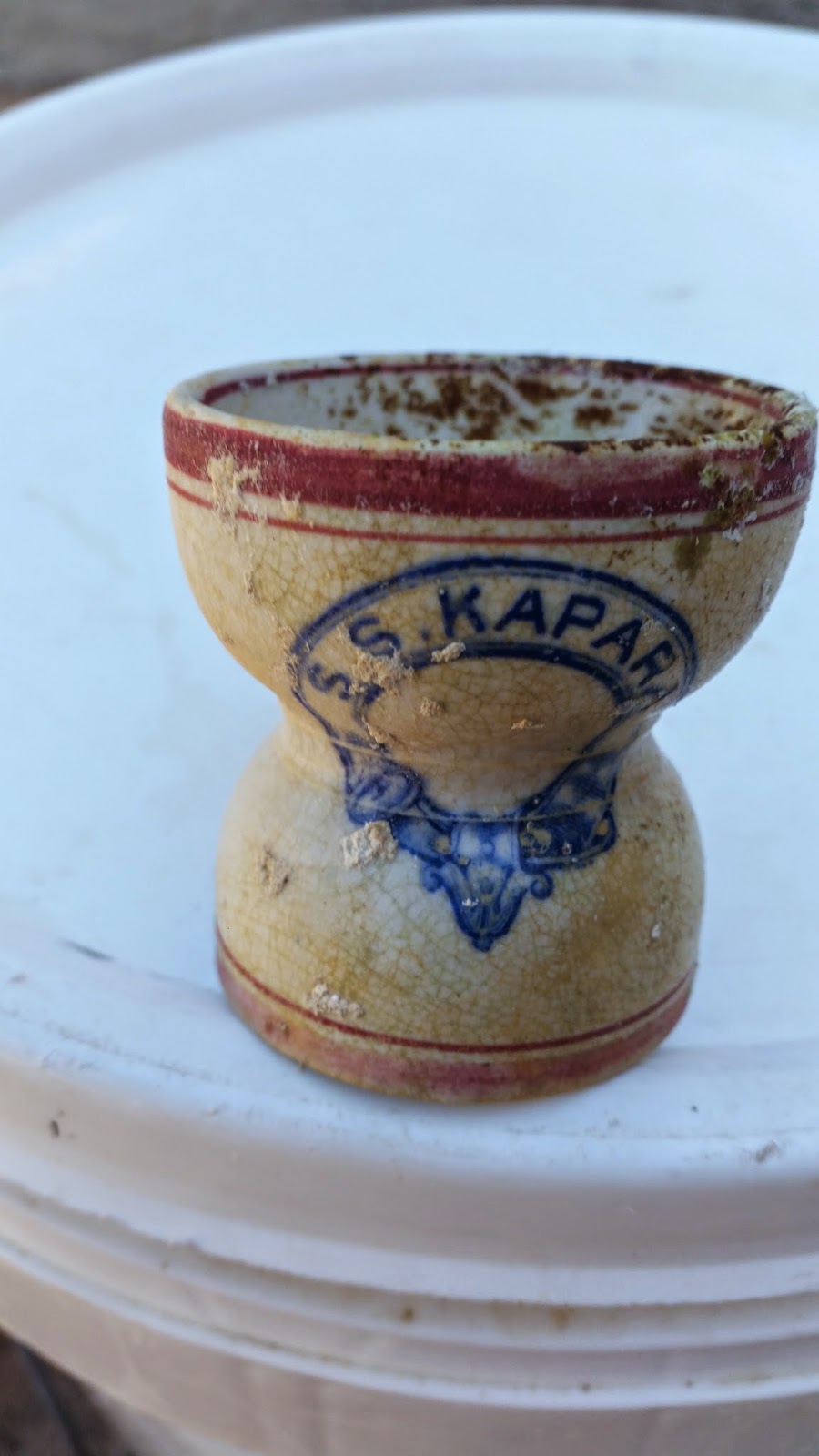
Egg cup found (from SS Kapara?)

SA diver, Andy Asser found this old egg cup whilst diving at Port Rickaby. The cup is decorated with the words "SS Kapara". The SS Kapara was a steamship built in Sunderland in 1914. She sank at Flinders Island in Nov 1942. Well done Andy.

Thursday, January 22, 2015

Pearl Harbor

I visited Pearl Harbor in O'ahu, Hawai'i last week. I was fortunate to see both the USS Arizona & the USS Utah (and their memorials), the USS Missouri, the USS Bowfin submarine museum and the other nearby ships.

My first visit was on the ground and on the water. I returned again via open-cockpit helicopter to view the scenes from the air.

Sunday, November 16, 2014

One of John Franklin's lost ships was located this year (2014)

Further to my article "The Connections Between Matthew Flinders, Sir John Franklin & Lord Hallam Tennyson" in the MLSSA Journal, No.20, 2010 ( http://web.archive.org/web/20140126063751/http://www.mlssa.asn.au/journals/2010journal.pdf )one of John Franklin's lost ships was located this year (2014). Visit http://www.traveller.com.au/franklin-ship-found-last-great-maritime-mystery-solved-10i964?utm_source=outbrain&utm_medium=cpc&utm_campaign=Outbrain_cpc for further details.

Friday, September 19, 2014

DISCOVERY OF THE WRECK OF THE NELSON

In September, the Great Lakes Shipwreck Historical Society (GLSHS) found the wreck of the Nelson, a large three-masted schooner built in 1866, in Lake Superior. The GLSHS found the 199’-long schooner in over 200’ of water. Society members were out in the organisation’s 50’ research vessel, the David Boyd, when they came across something on the sonar that appeared to be a shipwreck. Side-scan sonar is employed to analyze the lake bottom and identify submerged wrecks. They ultimately sent a diver down to take pictures and try to identify the wreck. Eric Foreman was the diver in question and he was the first person to see the ship in more than 100 years. It is said to be amazingly intact despite laying on the bottom of Lake Superior for 115 years. The vessel sank near Grand Marais, Michigan, in May 1899 after foundering in the midst of a spring gale, claiming the lives of all but one of the 10 on board. Only the captain survived. The Nelson, along with another schooner named the Mary Mitchell, was being towed towards Michigan’s Keweenaw Peninsula by the steamer A.Folsum on May 13, 1899 when the three vessels encountered rough waters caused by a spring gale. Captain AE White of the A.Folsum made the decision to turn the boats back to port when he noticed that the Nelson was lulling. The tow line snapped and the Nelson began to make a quick descent under water. Captain Hagginey/Haganey, the captain of the Nelson, quickly put his wife, infant child and the rest of the crew into a lifeboat before jumping from the sinking boat. By the time that he resurfaced, the ship was almost completely submerged and the lifeboat had been pulled under with it. The Captain's family and the rest of the crew all perished. The crew included the ship’s cook and a Richard Francis Cottrell. According to http://abc10up.com/shipwreck-society-discovers-148-year-old-wreck-of-lake-superior-coastline/ , “Captain Haganey of the Nelson remained aboard his sinking ship to lower the life-boat, which contained the crew, his wife and infant child. Once lowered, Captain Haganey jumped overboard to gain the lifeboat himself. He landed in the water, and upon surfacing witnessed the stern of his vessel rise up as the ship dove for the bottom. The line was still attached to the lifeboat, which took his crew and family along with the sinking ship.” Haganey himself survived after grabbing onto a piece of debris and eventually finding his way to shore at the Deer Park Life-Saving Station, where he was nursed back to health. The wreck-site is now being documented by the GLSHS for the Great Lakes Shipwreck Museum. The Museum is located at Whitefish Point, Michigan. It is open to the public seasonally from May 1 to October 31. The GLSHS is said to be a leader in the field of underwater exploration and shipwreck documentation on the Upper Great Lakes. The Society was founded in 1978 by a group of divers, teachers, and educators to commence exploration of historic shipwrecks in eastern Lake Superior, near Whitefish Point in Michigan’s scenic Upper Peninsula. It operates the Great Lakes Shipwreck Museum and the U.S. Weather Bureau Building, SooLocksPark, Sault Sainte Marie, Michigan. The Weather Bureau is open year-round. Visit http://abc10up.com/shipwreck-society-discovers-148-year-old-wreck-of-lake-superior-coastline/ for more details.