Sunday, November 30, 2025

The Hougomont Wreck

 As I wrote in my previous article about The barque Hougomont, the Hougomont was a 4-masted steel barque of 2378 tonnage (2378 gross tons, also said to be 2428 tons). The 89m-long vessel (89.08 X 13.21 X 7.29) was built by Scotts Shipbuilding & Engineering Co. in Greenock, Scotland in 1897.


(From the pamphlet "the wreck of the HOUGOMONT"

by the Yorke Peninsula Visitor Information Centre)

The vessel was scuttled at Stenhouse Bay on 8th January 1933 to become a breakwater by the Waratah Gypsum Company after being dis-masted in a storm whilst 950km (853km?) south of Cape Borda on 21st April 1932.


From the pamphlet "the wreck of the HOUGOMONT"

by the Yorke Peninsula Visitor Information Centre)

 According to the pamphlet "the wreck of the HOUGOMONT" by the Yorke Peninsula Visitor Information Centre, "the Hougomont rests in nine metres of water near the Stenhouse Bay jetty"


(From the pamphlet "the wreck of the HOUGOMONT"

by the Yorke Peninsula Visitor Information Centre)


Stenhouse Bay jetty

(From the pamphlet "the wreck of the HOUGOMONT"

by the Yorke Peninsula Visitor Information Centre)


The Juno wreck

The Juno wreck is one of the abandoned vessels in the Garden Island Ships’ Graveyard in the North Arm of the Port River, Port Adelaide. The Juno was a 241-ton steel-hulled screw steamer built by George Brown & Co. in Greenock, Scotland in 1903. It was placed between the Flinders and the Mangana in the ships’ graveyard in 1931. All three vessels were placed there in that same year (1931). The Juno is further in the mangroves than the Flinders and the Mangana. According to the “Garden Island Ships’ Graveyard Maritime Heritage Trail” booklet published by the Department for Environment and Heritage in 2001, “The Juno’s bow extends for approximately 4m into the mangroves with the forward collision bulkhead and foc’s’cle bulkhead evident.”


The booklet says that the Juno was ‘schooner-rigged’. It was built for the Coast Steamship Company in South Australia. Its dimensions were length 39.6m, breadth 7m, depth 2.6m.

It arrived in SA in February 1904 as a replacement for the smaller Ceres. According to the “Pioneer” newspaper for 27th February 1904, “Construction similar to the company's steamer Ceres, she is a counterpart of the latter vessel on a somewhat larger modern scale.  

The “Garden Island Ships’ Graveyard Maritime Heritage Trail” booklet says, “On or about 21 April 1931 the Juno’s remains were towed from the bank at the Port Adelaide slipway lease and abandoned at Garden Island.”

The South Australian Maritime Museum has these plans of the “General Arrangement of SS Juno: -

General Arrangement of SS Juno, Port Adelaide

(photograph by Catherine Manning, courtesy of the SAMM).

Erica-Jane Miller’s 2018 thesis titled “Treasured Collections - Memories, Ship Memorabilia and Connections Between People and Garden Island Ships’ Graveyard” (which I assisted her with) states, “The details of the plan are printed in white and have been drawn with a scale in mind (no scale is visible), appearing geometric is design.” The thesis describes several artefacts held by the SAMM from the Juno, plus a photo album and a sketchbook.


Erica-Jane mentions the Juno when discussing the photo album, “One of these ships pictured is Juno, known for providing transport and mail throughout the St Vincent Gulf region. ….. the image of Juno depicts the ship decks filled with many passengers, fluttering bunting flags and clear skies. This illustrates that a special occasion must have occurred, thus connecting the remains of Juno to an event important to the Port Adelaide community.”

In 2019, I managed to track down this bell from the Juno at the Largs Bay Primary School: -


It had been used as the school bell in earlier years when it was mounted in the school yard. It is now on display in the school office.

A 1928 photo of the Juno from an AJ Taylor postcard features in “Photographic Album of South Australian Passenger Vessels” by W. John Thomson (ISBN 064642922-1).

East Carolina University’s Nathan Richards’ thesis “Deep Structures: An Examination of Deliberate Watercraft Abandonment in Australia” (January 2002) is all about the Garden Island Ships’ Graveyard.


The H.A. Lumb Wreck

The deep-sea trawler and former tug the H.A. Lumb was scuttled off Port Noarlunga/O'Sullivan Beach as a recreational dive wreck by the Dive Industry Association of South Australia on 9th December 1994. The HA Lumb was a tug operating at Geelong, Victoria in the 1950s. It was scuttled close to the Port Noarlunga tyre reef. The fishing trawler Seawolf is located between the tyre reef and the H.A Lumb. The Seawolf was scuttled by the Seawolves Dive Club in March 2002.

According to the web page found at

http://www.environment.sa.gov.au/files/sharedassets/public/heritage/ha_lumb.pdf, “The (H.A. Lumb) measured 78.1 feet (23.8m) in length, 23.8 feet (7.3m) breadth, 8.8 feet (2.7m) depth and was 153 gross tons.

The Dive Industry Association of SA raised money to purchase the vessel. The vessel was stripped to make it visitor-friendly for both divers and marine life. Openings were enlarged and doors and potentially hazardous materials and structures removed. The tug Mudgee towed the H.A. Lumb to a site approximately 2 kilometres off O'Sullivan Beach, where it was scuttled in 20m of water.

Adelaide Scuba wrote on their Facebook page, “The H.A. Lumb, a steel tug built in 1943 by the Decatur Iron and Steel Company in Alabama in the United States, and registered to the US Navy. In 1956, it was brought to Geelong for use as a tug, and later converted to a deep-sea trawler in Port Lincoln. After serving as a deep-sea trawler, it was transformed into a popular dive site with the help of the Dive Industry Association, which raised funds to make it safe for both divers and marine life. On 9 December 1994, the tug was sunk in approx. 20m of water off O'Sullivan Beach, near the Port Noarlunga tyre reef. Today, it's a must-see for divers exploring South Australia’s underwater history!”

Photographer Greg Adams took the photos of the newly scuttled wreck that feature on the pdf H.A. LUMB – Port Noarlunga which is part of the Department for Environment and Heritage’s Ships’ Graveyard of South Australia gallery: -


The Glen Park wreck

The 3-masted, steel ship Glen Park (or Glenpark*) was wrecked at ‘Nor ‘Nor East Rock off Wedge Island on 1st February 1901. The ship had been built by A Roger and Co. in Glasgow, Scotland in 1897. Its dimensions are given as 265.8 x 40 x 23.6 feet in “Wrecks on the South Australian Coast” by Jack Loney. (1799-tons in “South Australian Shipwrecks – A Data Base (1802-1989)”, 1959-tons in “Wrecks on the South Australian Coast”.)

According to Garry Keywood in “Wedge Island – An Unexpected History”, the barque Elda (eventually) picked up 26 shipwrecked sailors from the Glen Park on 1st February 1901. The Glen Park had been wrecked off Nor’ Nor’ East Rock at Wedge Island about 8am that same morning. There were no casualties as all the crew were saved. They were all landed at Port Victoria.

Garry also sent me these photos of the wrecking of the Glen Park: -


The Glen Park  had been sailing under its master Captain Hugh Griffiths from Port Pirie to Guam with a cargo of almost 29,000 bags of wheat (figures vary) when it was wrecked at Wedge Island. According to “Wrecks on the South Australian Coast”, the Glenpark struck a rock about 6 km off Wedge Island and sank rapidly. The crew had little time to escape the ship.

According to Garry Keywood, “The Glen Park was beating slowly southwards in southerly winds, hence having to continually tack throughout the night of the 31st January 1901, & as early morning came there was a light mist obscuring visibility. At 5am, with no warning, the vessel struck Nor’ Nor’ East Rock near Wedge Island. The crew abandoned ship. Within a day, the Glen Park Had slipped off the rocky ledge  into 12 metres of water.”

Further, “George Lawrie was 8 years old when the Glen Park was wrecked off Wedge Island in 1901. He stated that “when the boat broke up, a lot of it floated (NW) to the Bolingbroke Shore …. “ According to the South Australian Maritime Museum’s Facebook page, “In the days following, parts of the wreck washed ashore along the coastline south of Tumby Bay”.

George Lawrie and his brother later found the figurehead of the Glen Park and their father used a team of horses to take the figurehead back to their home. The figurehead was eventually given to the Mortlock family who displayed it at the entrance to their Coffin Bay property. It is now on display at the South Australian Maritime Museum in Port Adelaide.

* (The Glen Park is listed in “South Australian Shipwrecks – A Data Base (1802-1989)” by Peter Christopher as ‘Glenpark’ (just one word). The same is repeated in “Wrecks on the South Australian Coast”. The South Australian Maritime Museum’s Facebook page, however, uses two words, even though their figureheads web page uses just the one word.)

Friday, November 28, 2025

Queensland’s wooden schooner Grace Darling shipwreck

The wooden schooner Grace Darling was built at Manning River, NSW in 1876. It was beached on Moreton Island, Queensland, where it eventually became a total wreck, on14th March 1894.

(The wooden schooner should not be confused with the 1907-built  steel steamship of the same name or the wooden topsail schooner Grace Darling that was built in Hobart, Tasmania in 1869 and was wrecked at Edwards Island, Lancelin, WA in 1914.)

According to the pdf file at https://www.qld.gov.au/__data/assets/pdf_file/0032/67964/dive-qld-shipwreck-grace-darling.pdf , the Grace Darling’s dimensions were “Length: 75ft Depth: 7.7ft Width: 21.1ft.” Its tonnage is given as 69 (gross tons (imperial tons).

Further, “The Grace Darling left Fisherman’s Island, Brisbane on 11 March 1894 with a cargo of 90 tons of coal, 440 cases of dynamite and 15 cases of detonators. Due to bad weather the captain decided to anchor the vessel off the Moreton Bay pilot station. On the afternoon of 14 March 1894, the wind increased to hurricane force and dragged the vessel towards the shore. The Grace Darling was so close to the beach that the ship’s master decided there was no chance of saving the vessel, so he beached the schooner on Moreton Island. The cargo was washed ashore, and the vessel eventually became a total wreck. No lives were lost.

“The wreck lies on a sandy bottom and can be partially covered by sand. The site largely consists of a considerable mound of coal (cargo) with fragments of wooden hull, copper fixing bolts and an oven. The coal mound is 1.5m above the sand and is orientated north-south with bow to south.

“The Grace Darling’s underwater superstructure is a habitat which provides food and shelter for a variety of marine life including sponges, corals, pelagic and reef fish, octopus and wobbegong sharks.”

The pdf includes maps and photos of the wreck site at Moreton Island: -


The 1869 wooden topsail schooner Grace Darling

The wooden topsail schooner Grace Darling was built in Hobart, Tasmania in 1869. It was wrecked at Edwards Island, Lancelin, WA in 1914.

The wooden schooner should not be confused with the 1907-built  steel steamship of the same name or another vessel of the same name that was wrecked in Queensland 20 years earlier in 1894.

According to the pdf file at https://www.qld.gov.au/__data/assets/pdf_file/0032/67964/dive-qld-shipwreck-grace-darling.pdf , “Grace Darling (1894). Vessel type -  Wooden sailing, schooner. Built - Manning River, New South Wales 1876. Dimensions - Length: 75ft Depth: 7.7ft Width: 21.1ft. Tonnage: 69. General information - The Grace Darling left Fisherman’s Island, Brisbane on 11 March 1894 with a cargo of 90 tons of coal, 440 cases of dynamite and 15 cases of detonators. Due to bad weather the captain decided to anchor the vessel off the Moreton Bay pilot station. On the afternoon of 14 March 1894, the wind increased to hurricane force and dragged the vessel towards the shore. The Grace Darling was so close to the beach that the ship’s master decided there was no chance of saving the vessel, so he beached the schooner on Moreton Island. The cargo was washed ashore, and the vessel eventually became a total wreck. No lives were lost.

“The wreck lies on a sandy bottom and can be partially covered by sand. The site largely consists of a considerable mound of coal (cargo) with fragments of wooden hull, copper fixing bolts and an oven. The coal mound is 1.5m above the sand and is orientated north-south with bow to south.

“The Grace Darling’s underwater superstructure is a habitat which provides food and shelter for a variety of marine life including sponges, corals, pelagic and reef fish, octopus and wobbegong sharks.”

But enough about the Queensland wreck. Garry Keywood sent me these photos and newspaper cutting that provide some of the history about the wooden topsail schooner Grace Darling that was built in Hobart in 1869 and was wrecked at Edwards Island, Lancelin, WA in 1914: -

A model of a ship on a table

AI-generated content may be incorrect.

A model of the wooden schooner Grace Darling

(Built by Bob Douglas)

A newspaper article with a ship

AI-generated content may be incorrect.A ship docked at a dock

AI-generated content may be incorrect.A screenshot of a museum

AI-generated content may be incorrect.


The SS Grace Darling

The SS Grace Darling was abandoned in the Garden Island Ships’ Graveyard in the North Arm of the Port River in 1931. 

The Grace Darling at anchorage

(Photo from the South Australian Maritime Museum Collection)

The 1907-built steel steamship was dismantled and then beached at Garden Island next to the Flinders on 19th June 1931.  The Moe  was placed alongside the Grace Darling  a few months later on 25th September 1931. The Grace Darling is now located between the Moe and the Flinders. The Stanley  and the Thomas and Annie are both close by amongst the mangroves.

The 622 (or 627)-gross ton Grace Darling was schooner-rigged. It was built at Hardinxveld, Netherlands for Port Adelaide’s John Darling and Company in 1907. John Darling and Company were flour millers in Port Adelaide. According to the “Garden Island Ships’ Graveyard Maritime Heritage Trail” booklet published by the Department for Environment and Heritage, “The steel-hulled vessel measured 175.0 feet (53.3m) in length, 27.0 feet (8.2m) breadth, 12.8 feet (3.9m) depth and was 622 gross tons.”

Chronometer from the Grace Darling

(Photo from the South Australian Maritime Museum Collection)

Garry Keywood sent me these photos and newspaper cuttings that provide some of the history of the Grace Darling: -

A boat in the water

AI-generated content may be incorrect.

A newspaper article with a boat

AI-generated content may be incorrect.

A close-up of a ship

AI-generated content may be incorrect.

A close-up of a newspaper

AI-generated content may be incorrect.

I took this photo of the Grace Darling in 2019: -

The 1907-built  steel steamship should not be confused with the wooden schooner of the same name: -
A model of the wooden schooner Grace Darling
(Built by Bob Douglas)

The wooden topsailschooner Grace Darling was built in Hobart, Tasmania in 1869. It was wrecked at Edwards island, Lancelin, WA in 1914.

I am told that there was another vessel of the same name that was wrecked in Queensland 20 years earlier in 1894.


Wednesday, November 26, 2025

The Garthneill Wreck


The Garthneill Wreck features in Peter Christopher’s book “South Australian Shipwrecks – A Data Base (1802-1989)”, but you’re not likely to find it in any other shipwreck book since it is only an abandoned vessel, rather than an actual shipwreck.

The Garthneill was a 1470-gross ton steel, 3-masted barque built in Glasgow, Scotland as the Inverneill, by Russell and Company in 1895. It was renamed the 'Garthneill' by Sir William Garthwaite, its new owner in 1916,. The ship’s dimensions are given as Length 238 feet, breadth 36 feet, depth 22 (21.7) feet. The ship was abandoned in the North Arm of the Port River in 1935 after having had most of its fittings removed. After being towed to the ships’ graveyard at Garden Island in the North Arm, its bow plates were cut away, and explosives were used to hole the vessel fore and aft.

The Garthneill had been decommissioned in 1926 and had its masts and rigging removed before being converted to become a floating grain mill (electric barley-grading plant and storeship). 


The Garthneill had a figurehead which is now on display in the South Australian Maritime Museum in Port Adelaide. It is described on the History Trust of South Australia’s Collections web page as “a white painted figure of a Scottish woman wearing a jacket and skirt, with a tam-o-shanter (hat) on her head. She holds a flower in her left hand.”


The South Australian Maritime Museum also holds some personal items linked to those who lived on the ship during its life as a floating silo and some fittings from when the ship was broken up and abandoned in the Port River.


According to the “Garden Island Ships’ Graveyard Maritime Heritage Trail ” booklet published by the Department for Environment and Heritage, the Garthneill’s forward section now lies partly hidden amongst the mangroves of Garden Island. It is positioned between the Mangana and the Glaucus in the ships’ graveyard.


This photograph shows the Garthneill in 2019: -


The Thomson, or Thomsons, or Thompsons, Shipwreck

According to “Shipwrecks of South Australia – A Data Base 1802 – 1989” by Peter Christopher, the 37-ton wooden cutter Thompsons (or Thomsons, or Thomson) was wrecked 5km south of Robe on 9th October 1849. The wreck is said to have been built in Sydney in 1837, with 22 casualties. The vessel’s dimensions are given as being 46 feet in length, 14 feet in breadth and 8 feet in depth (46.0 x 14.3 x 7.7 according to “Shipwrecks in South Australia (1836-1875)” by Ronald Parsons. These dimensions were also given in Jack Loney's books.)

Parsons says that the main mast of the vessel may have torn away during a gale, “making the cutter unmanageable, and that she swamped, and the heavy seas broke her into pieces.” Only parts of the vessel were found washed ashore. Peter Christopher’s book says that there was no salvage of the vessel, probably because it was discovered to be completely in pieces. Jack Loney said in two books that “the beach (was) littered with wreckage” and “only a few pieces of the vessel came ashore”.

“The Sixth Eleven Tales of Robe” by Pro Kathleen Bermingham gives the ship’s name as Thompson. Jack Loney’sWrecks at Robe” uses both Thomsons and Thomson

What is not clear is just how the name of the cutter was determined. It was presumably determined by broken parts of the vessel's name and put together like a jig saw puzzle

i.e. THOM   (P)  SON (S)

Although Jack Loney also used Thomsons in “Wrecks on the South Coast of South Australia” (1971-1975), he had changed it to Thompsons by 1993 in “the updated version titled “Wrecks on the South Australian Coast”. He had also changed the death toll from 21 lives to 22 lives for the updated version. The updated version is presumably the most accurate.

Both versions tell how Captain Wilkinson, his wife and child were amongst the victims. This is the grave site itself: -


Note that the plaques at the grave site use both Thomsons and Thomson: -


“Wrecks on the South Australian Coast” says that a woman’s body was found on the shore near the wreckage. This grave site plaque engraved for an “Unknown Drowned Female” is apparently for that woman (see further below): -


According to the Monument Australia web page for the Thomson Shipwreck Memorial, “The memorial plaques, were erected at the site of the unnamed grave, which contains the remains of some of the victims of the Thomsons Shipwreck, which occurred in 1849 with the loss of 21 lives*. The plaques were erected by the Women in Black Group from their cemetery tours.”

* (Rather than the 22 suggested in “Shipwrecks of South Australia – A Data Base 1802 – 1989”)

Further, “Perhaps one of the saddest stories belongs to the small plaque which reads: "Unknown drowned female, presumed from the wreck Thomson, 1849.'' In 1849, a woman was buried in the cemetery after sailors pulled her lifeless body from the shoreline, drifting among casks of wine and luggage. The woman was one of 21 people who drowned after the cutter Thomson ran aground in heavy seas. She remained nameless and without a memorial until the Women in Black group raised enough money from their tours to put a plaque over her remains.”

One of the plaques on the grave site is marked “The Highlander’s Grave”:  -


(Is a ‘Highlander’ just someone from the highlands somewhere or other, or does it mean something like a person from Scotland?)

“The Sixth Eleven Tales of Robe” says, “the cutter “Thompson” was wrecked half-way between Rivoli Bay and Guichen Bay with the loss of twenty-one men; seven of these were Highlanders, whose identity was marked by a simple wooden cross with the word “Highlander” on it in the Robe Cemetery.” (If there are 7 Highlanders, why was the more singular “Highlander’s” engraved on the plaque, rather than “Highlanders’”?” This plaque also gives the death toll as being 21 and suggests that there may be 6 or 7 Highlanders at the site. Perhaps this is part of the 21 or 22 dilemmas?

Both “Wrecks on the South Coast of South Australia” and “Wrecks on the South Australian Coast” says “The cutter Thompsons went ashore about 3 miles south of Guichen Bay during a heavy gale on the night of 10th September 1849, as opposed to 9th September.

So, there have been issues over the actual name of the vessel, the number of lives lost and the actual date of the wrecking. Ronald Parsons covered the whole issue in his book “Shipwrecks in South Australia (1836-1875)” when he used words and phrases such as:

“About September 10”, “the cutter THOMSON(S)”, “Thomson (frequently shown as ‘Thomsons’)”

“Wrecks on the South Australian Coast” says that local residents found wreckage from the ship the following morning, and the day after that too. The only actual pieces of the vessel that were recognisable were “the mast from the step to the level of the deck and her pump”.

Mr & Mrs Baxter and sister are said to have been amongst those who lost their lives in the wrecking. This plaque on a grave site for the victims of the shipwreck at Robe Cemetery is engraved for the "father, mother and daughter" from the "Baxter family": -


So, this is another small issue. Should it be the sister or the daughter? And 1847 is given as the year of the vessel being built in Sydney, as opposed to 1837. There clearly are several discrepancies and contradictions in this story.

Monday, November 24, 2025

The Wreck of the Steam Tug Nyora

I wrote “Discovery of the Wreck of the Nyora” for the July 2019 newsletter of the Scuba Divers Federation of SA. Details were repeated on the SDFSA column page in Dive Log magazine for the August 2019 issue: -

“The steam tug Nyora, sunk about 50kms off of Cape Jaffa in 1917 whilst towing the schooner Astoria. The Nyora was a single screw steamship built in 1909 by J.P. Rennoldson & Sons in South Shields (England). Whilst owned by Huddart Parker & Co Pty. Ltd, she foundered west of Kingston, SA after passing Kangaroo Island on a voyage to the eastern states with the auxiliary schooner Astoria in tow. The location for the wreck of the Nyora remained unknown until recently when Steve Saville found it.

“Video footage can be found at https://www.youtube.com/watch?v=8GqqHpfhmA8&feature=youtu.be  . See https://bit.ly/4py7AB7  for further details.”

The Nyora was a 306-gross ton steel steam tug 135 feet in length, was 25.1 feet wide and had a depth of 13.5 feet. It was built in 1909. “Shipwrecks of South Australia – A Data Base 1802 – 1989” says that there were 15 casualties when the ship was wrecked 19 km WSW of Cape Jaffa on 9th July 1917.

“Wrecks on the South Coast of South Australia” by J.K. (Jack) Loney says, “The Nyora was towing an American schooner (the Astoria) from Port Pirie to Sydney when struck by a gale and heavy seas. One enormous wave struck the small tug, and she foundered a short time after, about 12 miles off Cape Jaffa, watched by those on the helpless schooner.” Lightkeepers managed to save the captain (William McBain) and an able seaman (Gordon Lansley) as their waterlogged boat was being dashed against some rocks. Jack’s later version of the same book, “Wrecks on the South Australian Coast” says that the two Margaret Brock Reef lightkeepers (John Jameson and Robert ‘Tom’ Clark) “received medals from the Royal Humane Society (of Australasia) following their rescue of the only two survivors from the lost tug Nyora.” The silver medals, the second highest honour, were presented to the two men in August 1918

“Cape Jaffa – Its Memorial to Seafarers, Fishermen and Lightkeepers”  by John Nicholson devotes a whole chapter full of details about the Nyora incident. It includes details of the 4-masted auxiliary cargo schooner Astoria, which had only been built that same year (1917) in the town of the same name (Astoria) in Oregon, USA. Its engines had broken down off Gabo Island, Victoria, and it had to be towed to Port Pirie to off-load its cargo of timber before being towed to Sydney for repairs to its engines.

A total crew of 16 men is mentioned in regard to the Nyora, of which 15 perished when the tug went down stern first. The Astoria eventually made it back to shore at Guichen Bay. There is a photo of both Captain McBain and seaman Lansley. There is also a photo of the lightkeeper Robert ‘Tom’ Clark in the book.

The Nyora’s engine room doors had been smashed in by the heavy seas, and this was determined by a Marine Board Enquiry held at Port Adelaide the following week (16th July) to be the principle (sic) cause of the disaster.


The Nyora incident is remembered on the Memorial to Seafarers, Fishermen and Lightkeepers at King Drive, Cape Jaffa. I have had to review the number of men who died during the wrecking. I have seen figures of 15 & 16 for the crew and figures of 14 & 15 for the number that died. “Cape Jaffa – Its Memorial to Seafarers, Fishermen and Lightkeepers” lists just 14 names that are shown on the memorial. As mentioned above, a total crew of 16 men is mentioned in regard to the Nyora, of which 15 perished when the tug went down stern first. It is “Shipwrecks of South Australia – A Data Base 1802 – 1989” that says that there were 15 casualties from the wrecking, and the other books mentioned say that one of the crew was saved by the two lightkeepers. I have a cutting from an unnamed, undated (2002?) newspaper that stated that “14 crew drowned when the tug Nyora was lost off Cape Jaffa …” That is the figure given in “Cape Jaffa – Its Memorial to Seafarers, Fishermen and Lightkeepers”. The book also states that Captain William McBain “had a crew of fifteen”. If the captain himself is added to that figure, and one of the crew was saved along with the captain, then the loss of life would, indeed, be just 14 men, not 15 (if the case is as suggested here). Two further chapters in the book do not seem to clear up my query at all.

According to my article titled My Continuing "Encounter" Experiences, “The stone cairn memorial was dedicated during Encounter 2002 celebrations”. According to https://www.monumentaustralia.org/themes/disaster/maritime/display/50557-cape-jaffa-keepers-and-seafarers/photo/4 , the memorial was “Unveiled 15 - 4 – 2002”.

According to Steve Saville’s 2019, 4-minute YouTube video Nyora Steam Tug - Wreck Site Overview , “14 lives were lost. 2 crew survived”. The footage includes several images of the Nyora and an overview of the wrecksite. More details about those men that are listed on the memorial can be found at sefhg.org/index_files/jaffamem.htm.

A 2019 PowerPoint-type presentation of The Loss of the Nyora by Steve is 11.35 minutes long and it provides all of the details about the wrecking incident.

The Wreck of the Governor Gawler

 According to “South Australian Shipwrecks – A Data Base 1802-1989”, the 15 (or 16) ton wooden ketch Governor Gawler was wrecked (at Smith’s Rocks) in the Sir Joseph Banks Group on 1st August 1847. It says that the 35-foot-long ketch was “assembled Port Adelaide” in 1840. The crew and two passengers are said to have made it ashore on Reevesby Island.

According to Trove (Port Adelaide News and Lefevre's Peninsula Advertiser, Fri 11 Feb 1887), “Captain Underwood's ketch, Governor Gawler built at Port Adelaide, was the first specimen of South Australian marine architecture, special interest will be taken in her history.” Further, “of 16 tons, without deck (later decked).”

And “She was bound to Port Lincoln and had rounded Cape Spencer. The crew, comprising Thomas Cheeseman, then a lad, were below, when she was caught in a trap at one of the Sir Joseph Banks's group of inlands. To wear or to weather was impossible ; straight on the rocks the captain had to steer her. The vessel's bottom crashed in; those on board took to the boat, and hung on till daylight. Then with difficulty they landed, but next day hailed the Petrel, passing for Port Lincoln. They went off in the boat."

According to the Australasian Underwater Cultural Heritage Database, “The Governor Gawler was the first sailing vessel ‘built’ in South Australia, also the first to be wrecked (first SA-built to be wrecked?). Captain Emanuel Underwood arrived in Port Adelaide in 1840. He brought with him the Governor Gawler’s framework, sails, spars, ropes and tackle as part of the ships’ cargo. He then reconstructed the 35.3ft by 8.8ft by 7.9ft, two-masted vessel on the mudflats of the Port River. From 1841-1847 the Governor Gawler traded between Port Lincoln and Port Adelaide, but also carried cargo and passengers to Melbourne and Hobart Town.”

“Date wrecked: 01/08/1847. How vessel was wrecked: The Governor Gawler was making for Port Lincoln when driven northward by the storm, onto a reef near Reevesby Island, in the Sir Joseph Banks Group. The skipper, Captain Underwood, his crew and passengers had to survive the lifeboat overturning.”

The Wrecksite of the Dredge (aka the South Australian)

 As Adelaide Scuba posted on their Facebook page, “The iconic Dredge (South Australian), built in 1911 by A F Smulders at Schiedam, Holland, spent over 70 years shaping the waters of Port Adelaide and Outer Harbor. The vessel was a self-propelled sea going cutter suction dredge, measuring 41.9m in length, 9.0m breadth, 3.5m depth and 395 gross tons. After a long career of dredging and land reclamation, it was decommissioned in 1984 and scuttled off Glenelg in 1985 as part of an artificial reef program. Now sitting upright in approx. 18 metres of water, this fascinating wreck has become one of Adelaide’s top dive sites. Explore its intact structure and discover a piece of local maritime history!”

So, the Dredge (a.k.a. the South Australian) is still being described as ‘intact’ 41 years after its scuttling. I had written about the Dredge for the May 2008 issue of Dive Log magazine. It featured some of these photos: -


According to the Shipwrecks of South Australia web page, “Today the South Australian sits upright in approximately 20 metres of water. The vessel is intact, with the bow facing south. The wreck is the habitat of a variety of marine creatures and is one of Adelaide's most popular dive sites, providing limited opportunities for penetration and exploration.”

The Shipwrecks of South Australia web page also features these photos: -


Sunday, November 23, 2025

The Migrant Ship Marion Wrecksite

 As I wrote at Marion Bay & the wreck of the SS Willyama, “The 919-ton, three-masted, wooden (teak) migrant ship Marion was wrecked on a reef near the Troubridge Shoal …. in July 1851. Both Marion Reef and Marion Bay were named after this …. shipwreck when some of the survivors (360+ passengers & crew?) from it landed at Marion Bay. Another group of survivors landed at Cape Jervis.”

The anchor from the shipwreck has been on display in a glass and brick structure at Edithburgh since it was recovered in the 1970s: -


Details about the Marion and the wrecksite feature in the “Conserving our Historic Shipwrecks” booklet published by the State Heritage Branch of the Department of Environment and Planning in 1987. It says , “The  Marion was a three-masted wooden ship of 809 tons (Old Measurement) built at Quebec in 1850. ….. The vessel struck a reef just south of Troubridge Shoals in Gulf St Vincent on the night of 29 July 1851. …”

The booklet features this photo of a similar vessel to the Marion: -


It also features this photo of the wrecksite in 1983: -


According to the booklet, “The remains of the wooden hull, cargo and ship’s fittings are located on a shallow limestone reef, now known as Marion Reef, in 4 metres of water south of Troubridge Island (as at 1987). The iron knees, copper bolts, tree nails and wooden planking still retain the rough shape of the lower part of the hull. On top of these are thousands of items including bricks, clay furnace doors, ceramic ware and glassware. The site was extensively salvaged in 1872 but it still contains many interesting artefacts and ship’s fittings.”

The wreck of the SS Marion

 I wrote about the wreck of the SS Marion at Marion Bay & the wreck of the SS Willyama.

The SS Marion ran ashore about 1½ miles east of Cape Spencer in July 1862. She is said to have been wrecked in the bay already named Marion Bay after an earlier shipwreck. The 919-ton, three-masted, wooden (teak) migrant ship Marion was wrecked on a reef near the Troubridge Shoal, almost 11 years earlier, in July 1851. Both Marion Reef and Marion Bay were named after this earlier shipwreck when some of the survivors (360+ passengers & crew?) from it landed at Marion Bay. Another group of survivors landed at Cape Jervis. A one-masted wooden cutter called Marion was broken up at Louth in South Australia around 1912.)

OLYMPUS DIGITAL CAMERA

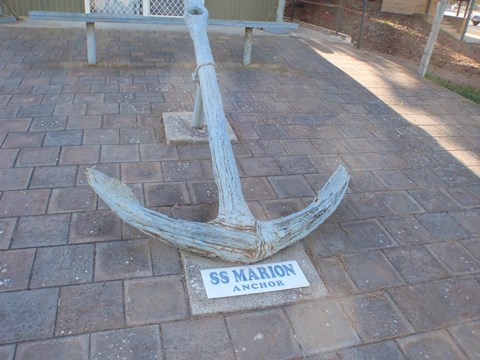
An anchor from the SS Marion located at the Marion Bay Historical Centre
(Photo: Steve Reynolds)

OLYMPUS DIGITAL CAMERA

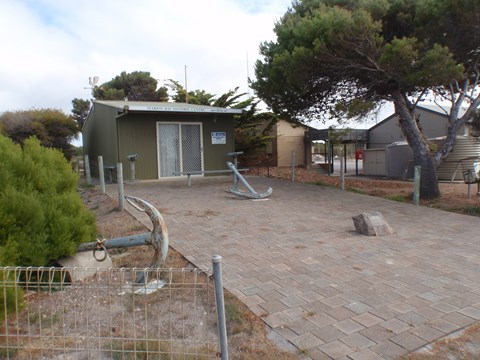
Marion Bay Historical Centre with anchors from the Willyama (left) & the Marion (rear)
(Photo: Steve Reynolds)

According to Yorkes Live’s web page “Shipwrecks On Yorke Peninsula”, “The wreck of the S.S. Marion lies at the base of a cliff, in 2-7 metres of water, east of Chinamans Hat Island, and to the south-east of the car park at Cable Hut Bay.” This either originated from the “Investigator Strait Maritime Heritage Trail” booklet published by the State Heritage Branch of the Department of Environment and Natural Resources in 1996, or is repeated in that booklet.

The location of the wreck (in both cases) is given as being:

Latitude 35° 17' 17.1" South, Longitude 136° 55' 18.4" East

The booklet includes a map of the location for the wreck and a map of the wreck site.

According to the booklet (as at 1996), “Little of the hull structure remains to be seen because the wreck, which is scattered on a northerly axis for a distance of some 60 metres, is located on a predominantly rocky bottom in a high energy zone. The wreckage is divided into two distinct locations with the forward part of the ship broken and scattered over a shallow reef shelf, and the tern lying in an area of patchy sand in deeper water at the base of the reef.

“Amongst the wreckage of the stern the rudder is clearly visible lying at a depth of 7 metres, with the Propeller shaft about 8 metres further inshore. Remains of machinery, possibly the engine, can be seen

 Nearby. Seaweed and rocky crevices obscure the scattered remains of the bow, but frames, beams and the remnants of other structures can be identified. Fragile artefacts, part of cargo and fittings, can be lodged in crevices in the rock platform.”

The Wreck of the SS Willyama

 I wrote about the SS Willyama at Marion Bay & the wreck of the SS Willyama in 2014.

“The 2704-ton (or 2705t) SS Willyama sank in Marion Bay, near Rhino Head, on 13th April 1907. She had been built, just 10 years earlier, in 1897 (for the Adelaide Steamship Co.). Her cargo was 4000 tons of coal from Newcastle. This coal, which was bound for Port Pirie, is said to have “provided many (of Yorke) peninsula’s residents with a private coal supply, at no charge, for many years” (“Yorke Peninsula Shipping” by Ronald Parsons).”

Geoff Mower wrote an article about the wreck   for the November 1980 MLSSA Newsletter. The article was accompanied by this sketch of the wreck site. You can click on the image to read his original dive report.

Sketch of the wreck of the Willyama - Geoff Mower, November 1980

Sketch of the wreck of the Willyama – Geoff Mower, November 1980

The Willyama hit a reef on 13th April 1907). She was actually abandoned during a salvage attempt on 25th April 1907 (Anzac Day) when she became damaged during rough weather.

OLYMPUS DIGITAL CAMERA

The wreck of the Willyama can be seen from this viewing platform at Willyama Beach
(Photo: Steve Reynolds)

OLYMPUS DIGITAL CAMERA

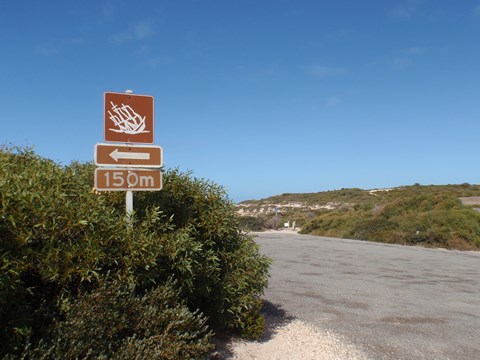
This sign pointing to the wreck site is in the area where Geoff and his buddy probably camped prior to November, 1980
(Photo: Steve Reynolds)

OLYMPUS DIGITAL CAMERA

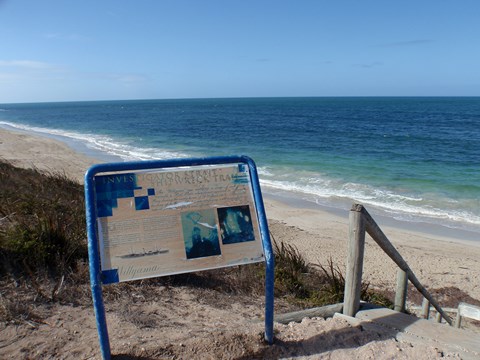
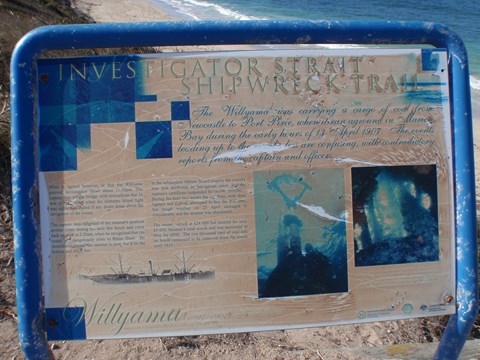
This interpretive sign is now located close to the wreck site
(Photo: Steve Reynolds)

OLYMPUS DIGITAL CAMERA

A close-up shot of the sign
(Photo: Steve Reynolds)

I tried getting a good shot of the wreck site from several locations along Willyama Beach. This appears to be the best shot that I managed to get of the site: –

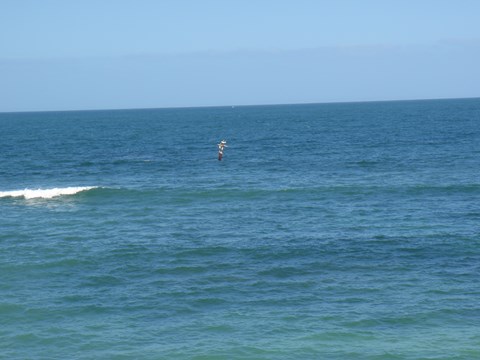
OLYMPUS DIGITAL CAMERA

The steering gear of the Willyama protrudes above the surface of the water even at high tide
(Photo: Steve Reynolds)

The location of the boiler was almost discernible just beyond the steering gear. I also tried to get a shot of Rhino Head in the distance from several locations along Willyama Beach and at Stenhouse Bay. This appears to be the best shot that I managed to get of it: –

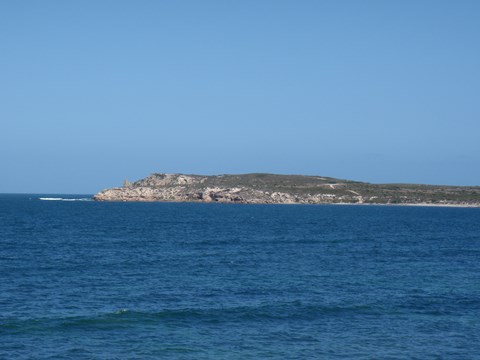
OLYMPUS DIGITAL CAMERA

Rhino Head in the distance
(Photo: Steve Reynolds)

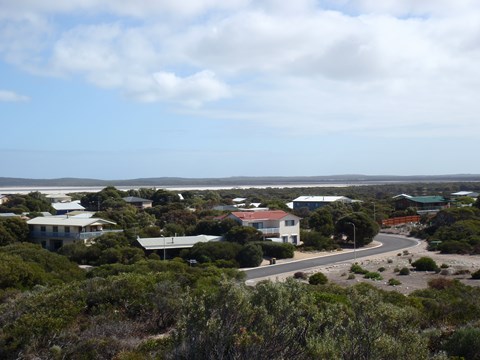
It seems that a housing estate is now located in the area where Geoff camped prior to November 1980: –

OLYMPUS DIGITAL CAMERA

A housing estate is now located in the area where Geoff camped prior to November 1980
(Photo: Steve Reynolds)

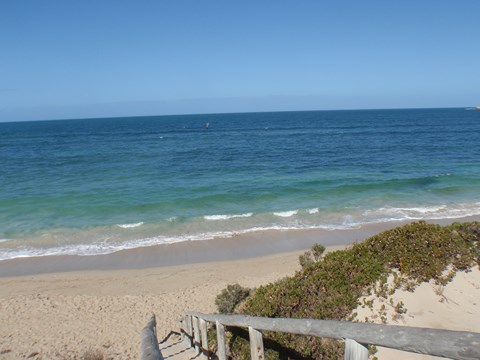
There are now some steps leading down to the beach at the wreck site: –

OLYMPUS DIGITAL CAMERA

Steps leading down to the beach at the wreck site
(Photo: Steve Reynolds)

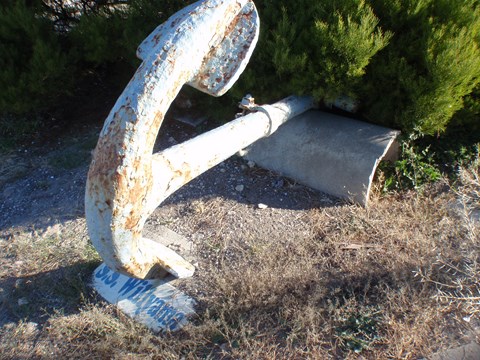
An anchor from the Willyama is located at the Marion Bay Historical Centre, along with an anchor from the SS Marion (of 1862). The Historical Centre was opened in October 1997. Unfortunately, the anchor from the SS Willyama is starting to disappear under a nearby shrub.

OLYMPUS DIGITAL CAMERA

Marion Bay Historical Centre with anchors from the Willyama (left) & the Marion(rear)
(Photo: Steve Reynolds)

Here is a close-up shot of the anchor from the Willyama: –

OLYMPUS DIGITAL CAMERA

An anchor from the SS Willyama located at the Marion Bay Historical Centre
(Photo: Steve Reynolds)

According to https://www.youtube.com/watch?v=ql1UK7mzIAA , the Adelaide Freedive Tribe posted 2019 video footage of “Freediving the SS Willyama Shipwreck”. It was suggested, however, that “the conditions are rarely favourable enough to dive it”.